Everyone Gets a Seat at the Table
There’s a guy I think about when we’re building salty.poker.
I used to see him at the card room regularly. Mostly paralyzed. He’d roll up next to the dealer, and when it was his turn to act, he’d tell the dealer what he wanted to do. Check. Call. Raise to thirty. The dealer would handle the chips and the cards. He handled the poker.
Nobody at the table blinked. He was just a player. A good one, actually.
That guy deserves to play online just as much as anyone else. And right now, most poker platforms would make it nearly impossible for him to do that. That’s not acceptable to us.
Accessibility Isn’t a Checkbox
When most software teams talk about ADA compliance, they mean they did the minimum — slapped some alt text on images, checked a box, moved on. We’re not interested in that version.
Accessibility is a design principle, not a legal formality. It means building a platform that works for the full range of people who want to use it — including people who experience the world differently than the assumed default user.
For a poker platform, that means a few things specifically.
Color Blindness
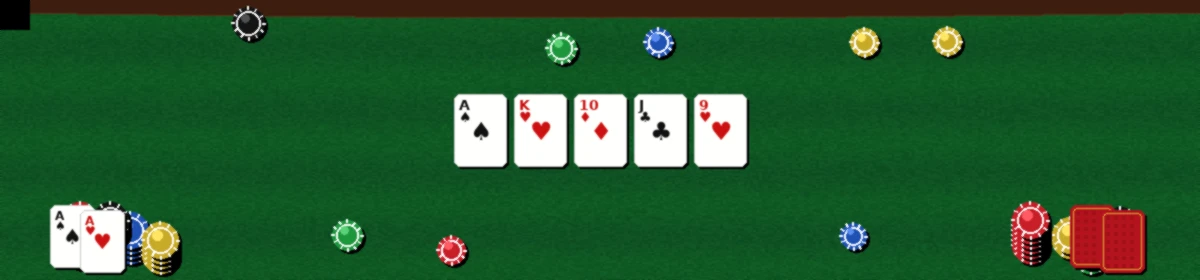
Roughly 8% of men and 0.5% of women have some form of color vision deficiency. Red-green color blindness is the most common. In poker, where suit recognition is fundamental to reading a hand, a platform that relies solely on color to distinguish suits is actively excluding a meaningful portion of its players.
salty.poker will ship with full color blindness support. That means multiple color themes, suit symbols that are distinct by shape — not just color — and card displays that are readable regardless of how you perceive color. If you’ve ever squinted at a card on another platform and genuinely couldn’t tell if it was a heart or a diamond, that’s a problem we’re solving before launch, not after.
Keyboard Navigation and Custom Mapping
Mouse-dependent interfaces lock out players who navigate differently — whether due to motor disabilities, tremors, limb differences, or simply a preference for keyboard control. Every core action on salty.poker will be accessible via keyboard. Fold, check, call, raise, confirm — all of it navigable without a mouse.
We’re also building in customizable keyboard mapping. You set the keys that work for you. If you need larger click targets, slower timeout defaults, or a layout that accommodates assistive technology, those controls will be there.
The guy next to the dealer had someone else move his chips. On salty.poker, we want to be the software equivalent of that dealer — handling the mechanical execution while the player does what matters: making decisions and playing poker.
Customizability as an Accessibility Feature
Customization and accessibility are closer to the same thing than most platforms acknowledge. A player with low vision needs larger text and higher contrast. A player managing hand tremors needs more forgiving click targets and generous action timers. A player using a switch device or eye-tracking software needs clean, predictable navigation flow.
These aren’t edge cases. These are players — people who love poker and deserve a platform that loves them back.
salty.poker is being built with configurable UI scaling, high contrast modes, adjustable action timers, and audio cues for game events. Not as add-ons. As part of the core platform.
Why This Matters to Us
I’ve played live poker with people who navigate accessibility challenges every session. I’ve watched them adapt, improvise, and rely on the goodwill of dealers and other players to participate fully. That works in a room where people know each other. It doesn’t scale to an online platform where the software either works for you or it doesn’t.
salty.poker should work for everyone. The recreational player with red-green color blindness. The competitive player with limited hand mobility. The guy who used to tell his dealer what to do and would absolutely destroy you in a heads-up pot.
Everyone gets a seat at the table. We’re building the table to make sure of it.